

Write My Case Study: A Complete Guide to Case Study Writing and Academic Support
A case study assignment can be challenging when you need to understand a complex situation, examine evidence and explain what your findings mean. Students in business, nursing, education, psychology, law and other fields often use case studies to explore real-life problems. These assignments require more than a summary of events. They involve careful research, critical thinking and clear explanations.
If you have searched for "write my case study," you may be looking for guidance on how to begin, how to organise your ideas or how to analyse a difficult topic. You may also need help with academic language, referencing or understanding your assignment instructions.
This guide explains how to approach a case study, develop a clear structure, analyse evidence and improve your final paper. It also explains how academic writing support from EssayNut can help you build your skills while keeping your work consistent with your institution's academic integrity requirements.
What Is a Case Study?
A case study is a detailed examination of a particular person, organisation, event, group or situation. It explores a specific issue within its real-world context. Researchers and students use case studies to understand why something happened, how a problem developed and what can be learned from the available evidence.
For example, a business student may examine why a company is losing customers. A nursing student may analyse a patient's care needs using an approved educational scenario. An education student may explore how a teacher supports a child with additional learning needs.
The purpose of a case study is to connect theory with practical situations. It allows students to apply concepts from their course and develop explanations based on evidence.
Case studies can use qualitative information, quantitative data or a combination of both. Qualitative evidence may include interviews, observations and documents. Quantitative evidence may include financial figures, survey results and performance measures.
The type of evidence depends on the case, the research question and the assignment requirements.
Why Do Students Find Case Study Assignments Difficult?
Case study assignments often combine several academic skills in one task. Students must understand the scenario, identify the central problem, locate credible sources and develop an evidence-based analysis.
Some common challenges include:
-
Understanding what the assignment question requires.
-
Identifying the main issue within a large amount of information.
-
Applying theories and concepts correctly.
-
Separating facts from assumptions.
-
Finding reliable academic sources.
-
Developing recommendations that follow from the evidence.
-
Using the required referencing style.
-
Meeting the word count and submission deadline.
A common mistake is spending too much time describing the case and too little time analysing it. A strong case study explains what happened, examines why it happened and considers what the evidence suggests.
The University of New South Wales explains that academic work must reflect the student's own contribution and that submitting work completed by another person can constitute academic misconduct (UNSW Sydney, n.d.). Students should therefore check their institution's rules before using external writing, editing or tutoring services.
Types of Case Study Assignments
Different disciplines use case studies for different purposes. Understanding the type of assignment helps you select the right structure and evidence.
|
Case study type |
Main purpose |
Example |
|---|---|---|
|
Business case study |
Examine organisational problems and decisions |
Analysing falling sales |
|
Nursing case study |
Explore patient care and clinical reasoning |
Reviewing a simulated patient scenario |
|
Education case study |
Understand learning, teaching or behaviour |
Examining classroom inclusion |
|
Psychology case study |
Explore behaviour or psychological concepts |
Analysing a fictional client scenario |
|
Legal case study |
Apply legal principles to a situation |
Identifying issues in a hypothetical dispute |
|
Research case study |
Investigate a particular setting or phenomenon |
Studying community responses to change |
The assignment brief should determine which approach you use. A nursing case study, for example, may require clinical reasoning and a care plan, while a business case may focus on strategy, financial performance and organisational decisions.
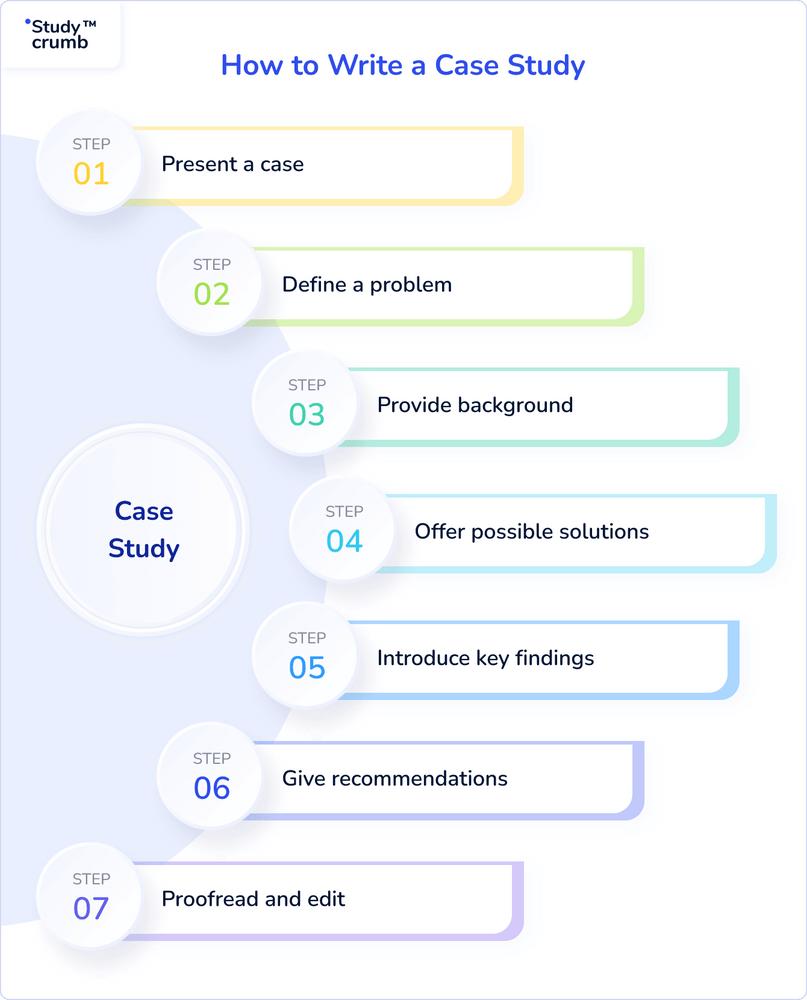
How to Write a Case Study Step by Step
A clear process makes a case study easier to manage. The following steps can help you move from an assignment question to a well-organised analysis.
Step 1: Read the Assignment Instructions
Start by reading the question, marking criteria and submission guidelines. Identify the task's main purpose and the information you must include.
Look for instruction words such as analyse, evaluate, compare, discuss and recommend. Each word requires a different response.
For example, "describe the company's marketing strategy" asks you to explain what the company does. "Evaluate the company's marketing strategy" requires you to examine its strengths, limitations and results using relevant evidence.
Create a checklist of the required sections, word count, referencing style and submission date. If an instruction is unclear, ask your lecturer or tutor for clarification.
Step 2: Understand the Case
Read the case material carefully. Identify the people or organisations involved, the setting, the timeline and the main events.
Separate the information into three categories:
-
Facts explicitly provided in the case.
-
Relevant evidence from academic or professional sources.
-
Questions or assumptions that require further investigation.
This approach helps prevent unsupported conclusions.
Consider a fictional company experiencing declining sales. The case may report lower customer numbers, increased operating costs and negative customer feedback. These are different pieces of evidence. Your task is to investigate how they relate to the central problem rather than assume that one factor explains everything.
Step 3: Identify the Main Problem
A case study may contain several issues, but your assignment usually requires you to focus on one central question or a small group of related problems.
Write the problem in one clear sentence. Then identify the evidence that supports it.
For example:
The company is experiencing declining customer retention, potentially linked to customer dissatisfaction and increased competition.
This statement identifies the issue while leaving room for investigation. The word "potentially" is important because the evidence may not establish a direct cause.
Your problem statement should guide the rest of the paper. Each section should contribute to answering the assignment question.
Step 4: Conduct Academic Research
Use your university library, scholarly databases and credible professional sources to find relevant evidence. Google Scholar can help you discover research papers, while databases available through your institution may provide access to full-text publications.
Useful sources include peer-reviewed journal articles, academic books, government reports, professional guidelines and original case documents.
Evaluate sources before using them. Check the author's expertise, publication date, evidence and relevance to your question. Older sources may still be appropriate for established theories, while current statistics and professional guidelines may require more recent material.
Keep a record of each source as you research. Note the author's name, publication year, title, DOI or URL, and the main finding relevant to your argument.
The Purdue Online Writing Lab provides guidance on academic research and citation practices that can help students organise and acknowledge their sources (Purdue Online Writing Lab, n.d.).
Step 5: Apply Relevant Theories and Concepts
Academic case studies should connect the situation to ideas from your course. Choose theories that help explain the evidence rather than adding concepts simply to increase the number of citations.
For example, a business student investigating employee motivation might use an established motivation theory to interpret workplace behaviour. An education student might apply a learning theory to examine a teaching scenario.
Explain the theory briefly, identify its relevant concepts and apply those concepts to the case. Then consider whether the evidence supports the explanation or reveals limitations.
A useful analytical paragraph follows this pattern:
-
Claim: State the point you are making.
-
Evidence: Present relevant case information or research.
-
Explanation: Explain how the evidence supports your point.
-
Connection: Link the analysis to the research question.
This structure keeps your discussion focused and helps readers follow your reasoning.
Step 6: Develop Evidence-Based Recommendations
Some case study assignments ask you to recommend solutions. Each recommendation should respond to an identified problem and be supported by the analysis.

Avoid general suggestions such as "improve communication" without explaining what should change.
A more useful recommendation identifies the action, responsible person or team, resources required and expected outcome. It may also explain how progress could be measured.
Recommendations should be realistic. Consider the available budget, time, staffing, legal requirements and possible risks.
Where the evidence is limited, acknowledge the uncertainty. A recommendation based on incomplete information should not be presented as a guaranteed solution.
Step 7: Write and Edit the Case Study
Once your research and outline are ready, write the sections in a logical order. Focus on developing your own explanation of the evidence.
After completing the first draft, check whether every paragraph contributes to the assignment question. Remove repeated ideas and unsupported claims. Review the connection between your analysis and recommendations.
Editing should also cover grammar, sentence structure, paragraph flow and academic tone. Check that every source cited in the text appears in the reference list and that the reference list contains no unused sources.
Recommended Case Study Structure
The exact structure depends on your discipline and assignment instructions. The following format provides a starting point.
|
Section |
Purpose |
Suggested share of words |
|---|---|---|
|
Introduction |
Introduce the case, purpose and main issue |
10% |
|
Case background |
Explain the relevant context |
15% |
|
Problem identification |
Define the main issue |
10% |
|
Analysis and discussion |
Apply theories and evaluate evidence |
40% |
|
Recommendations |
Present evidence-based actions |
15% |
|
Conclusion |
Summarise the main findings |
10% |
These percentages are an illustrative planning guide, not a universal academic rule. Follow your assessment rubric if it specifies a different structure.
For a 2,000-word assignment, this guide would allocate approximately 800 words to analysis and discussion. That gives the central reasoning enough space while keeping the background concise.
How to Analyse a Case Study Effectively
Case study analysis requires you to examine relationships between evidence, concepts and possible explanations. A summary tells readers what happened. An analysis explains the significance of those events.
Consider the fictional example below.
|
Evidence in the case |
Possible interpretation |
Further evidence needed |
|---|---|---|
|
Customer retention has declined |
Customers may be dissatisfied |
Customer feedback and retention data |
|
Operating costs have increased |
Profit margins may be under pressure |
Financial statements |
|
A competitor has entered the market |
Competition may affect customer choices |
Market share and pricing data |
The table shows why it is important to distinguish evidence from interpretation. A decline in customer retention does not automatically prove that customer service is poor. Other explanations may include pricing, product changes or competitor activity.
A careful analysis considers alternative explanations and explains why one interpretation is supported by the available evidence.
Common Case Study Writing Mistakes
Avoid these common problems when preparing your assignment.
|
Mistake |
How to improve it |
|---|---|
|
Repeating the case without analysis |
Explain the meaning of important facts |
|
Making claims without evidence |
Support claims with reliable sources |
|
Using irrelevant theories |
Select concepts that answer the question |
|
Giving vague recommendations |
Specify actions and expected outcomes |
|
Ignoring alternative explanations |
Consider other factors and limitations |
|
Overusing quotations |
Explain research findings in your own words |
|
Incorrect referencing |
Follow the required citation style |
|
Adding unnecessary background |
Include only information relevant to the analysis |
Academic integrity is also important. Buying a completed assessment and submitting it as your own may breach university rules. The University of Bristol identifies paid third-party completion of an assessment as an example of contract cheating and outlines the potential academic and personal risks (University of Bristol, n.d.).
APA 7 Referencing in a Case Study
APA 7 is widely used in fields such as psychology, education, nursing and social sciences. However, you should confirm which referencing style your lecturer requires.
APA 7 generally uses an author-date system. A paraphrased idea includes the author's surname and publication year. A direct quotation also requires a page number or another suitable location marker when available.
For example, a paraphrase may appear as:
Research on academic writing highlights the importance of acknowledging the ideas and evidence used in scholarly work (Author, 2024).
The reference list provides the complete details needed to locate the source. For a journal article, this normally includes the author, year, article title, journal title, volume, issue, page range and DOI when available.
Do not create references from incomplete information or cite articles you have not checked. Accurate referencing allows readers to locate the original evidence and evaluate the claims in your case study.
How EssayNut Can Support Your Case Study Preparation
Students sometimes need help understanding an assignment, organising their research or improving the clarity of a draft. EssayNut can be presented as a point of contact for academic writing guidance, subject to the specific services offered and the rules of the student's institution.
Before requesting assistance, prepare your assignment brief, marking rubric, draft and questions. This gives a tutor or editor a clearer understanding of the areas where you need support.
Useful forms of support may include:
-
Explaining case study structure and academic conventions.
-
Helping you plan a research strategy.
-
Providing feedback on the clarity of your own draft.
-
Identifying areas that need stronger evidence.
-
Explaining APA 7 referencing.
-
Supporting grammar and proofreading within permitted limits.
Students should confirm the scope of any service before paying. They should also check their institution's rules on external editing, tutoring, AI tools and other forms of assistance. The University of Sydney explains that completing an assessment for another student, including through paid services, can constitute contract cheating (University of Sydney, n.d.).
Frequently Asked Questions About Case Study Writing
1. How do I start a case study assignment?
Start by reading the assessment question and marking rubric. Identify the main issue, collect relevant evidence and prepare an outline. Once you understand the case, develop a clear problem statement that guides your analysis.
2. How long should a case study be?
The required length depends on your course and assessment instructions. Some case studies are short reports, while others require several thousand words. Follow the assigned word count and use your space mainly for analysis and evidence.
3. What is the difference between a case study and an essay?
An essay usually develops an argument around a question or topic. A case study examines a specific situation in detail and applies evidence or theory to understand its problems, causes and possible responses. Both require clear reasoning and credible sources.
4. Can I use APA 7 for a case study?
Yes, if your institution or lecturer requires APA 7. Use author-date citations in the text and provide a complete reference list. Always follow any additional formatting requirements in your assessment instructions.
5. Where can I get help with my case study?
Start with your university's academic skills centre, library, lecturer or approved tutoring service. You can also contact EssayNut to enquire about available writing guidance and feedback. Check that the assistance you request is permitted by your institution.
Conclusion: Prepare Your Case Study With Confidence
Writing a case study involves understanding a situation, identifying its central problem, researching reliable evidence and developing a clear analysis. A strong paper connects relevant theories to the case, considers alternative explanations and presents recommendations that follow from the findings.
Planning your structure, keeping accurate research notes and reviewing your work against the marking rubric can make the process more manageable. Academic writing support may also help you strengthen your research, organisation and communication skills, provided the assistance follows your institution's academic integrity rules.
If you need guidance with your next case study, contact EssayNut to ask about available support for planning, research skills, referencing and feedback on your own writing.
Need help preparing your case study?
Contact EssayNut to discuss your assignment requirements and ask about available academic writing support.
+1 (607) 286-5376
References
Purdue Online Writing Lab. (n.d.). Research and citation resources. Purdue University. https://owl.purdue.edu/
University of Bristol. (n.d.). Contract cheating. https://www.bristol.ac.uk/students/support/academic-advice/academic-integrity/contract-cheating/
University of New South Wales. (n.d.). Cheating. https://www.unsw.edu.au/assurance-integrity/conduct-integrity/cheating
University of Sydney. (n.d.). Academic integrity breaches. https://www.sydney.edu.au/students/academic-integrity/breaches.html